Training essentials · Step 4 of 4
Review to answer a question.
“Am I progressing on this exercise?” is more useful than “Was my last workout good?” One session can fluctuate. Several comparable sessions show whether your current approach is moving toward its targets.
Make a short review part of your routine. The end of the week can work well once you have repeated sessions to compare. Pick one or two main exercises rather than trying to explain every number. Start with completed sets, not an overall score.
Read the sets as a story.
Our Chest Press example moved from 55 kg for 8, 8, 7 to 8, 8, 8, then 9, 8, 8. That is progress in completed reps before any weight increase. Later, 10, 10, 10 at the intended effort justified moving to 57.5 kg. Returning to eight reps at that load was part of the plan, not starting over.
In Strength Direct, open Exercises → choose the exercise → History. Read the dates, completed sets, and notes together. Ask:
- What improved? Reps at the same load, or load at similar reps?
- Was it the same task? Comparable equipment, setup, range of motion, and rest?
- Was the effort similar? An extra rep taken to failure is not the same comparison as an extra rep with two left.
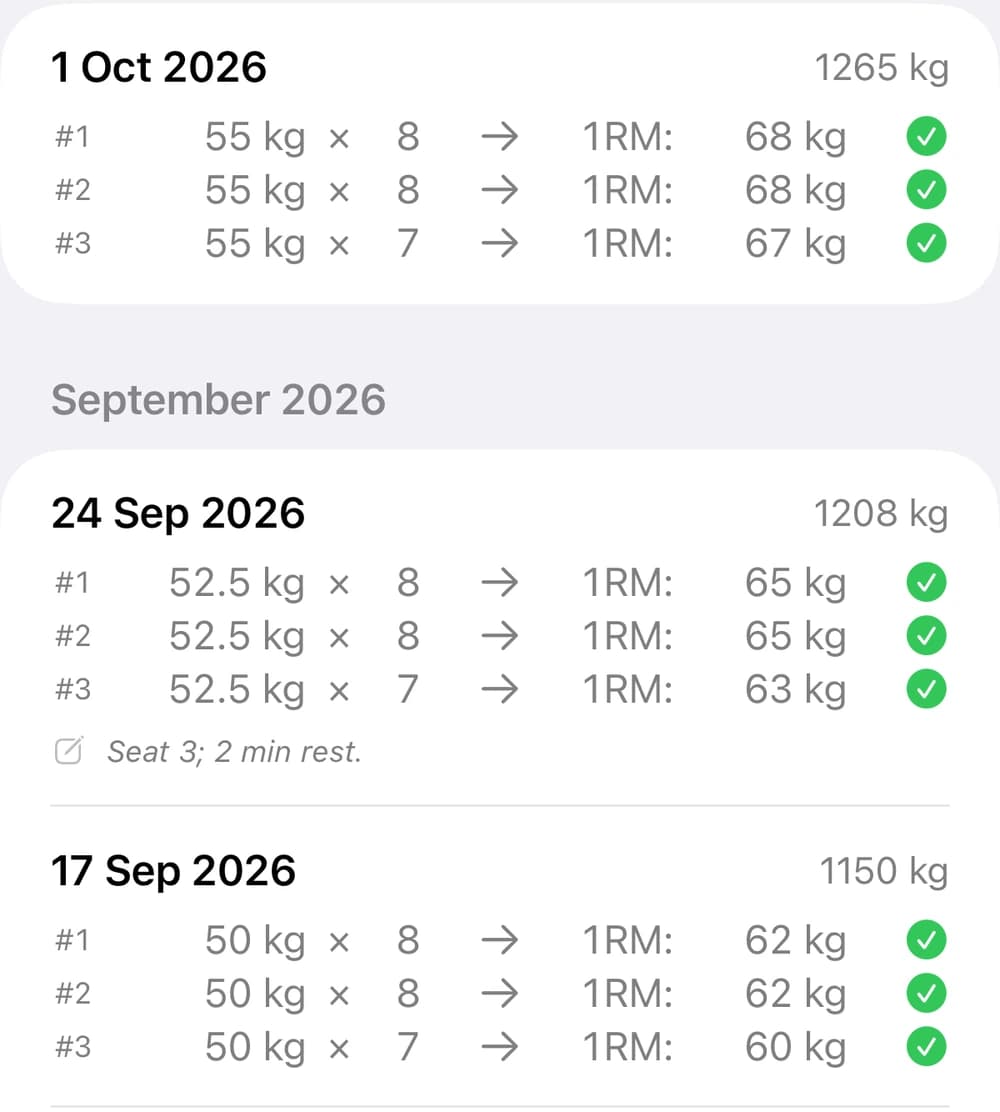
- This earlier part of the fictional Chest Press history shows 50 → 52.5 → 55 kg, with sets of 8, 8, 7 each time.
- A short session note preserves setup and rest context. The numbers are more useful when you know what stayed the same.
If you changed machines or technique, keep the new record, but establish a fresh reference rather than treating the numbers as interchangeable. More total volume from extra sets also does not, by itself, prove that you got stronger.
Use the chart to find a pattern. Check the sets to explain it.
When load and reps both change, an estimated one-rep max (e1RM) offers another way to compare performance. Open the exercise’s Analytics view to see its trend, then return to the sessions behind a rise or dip.
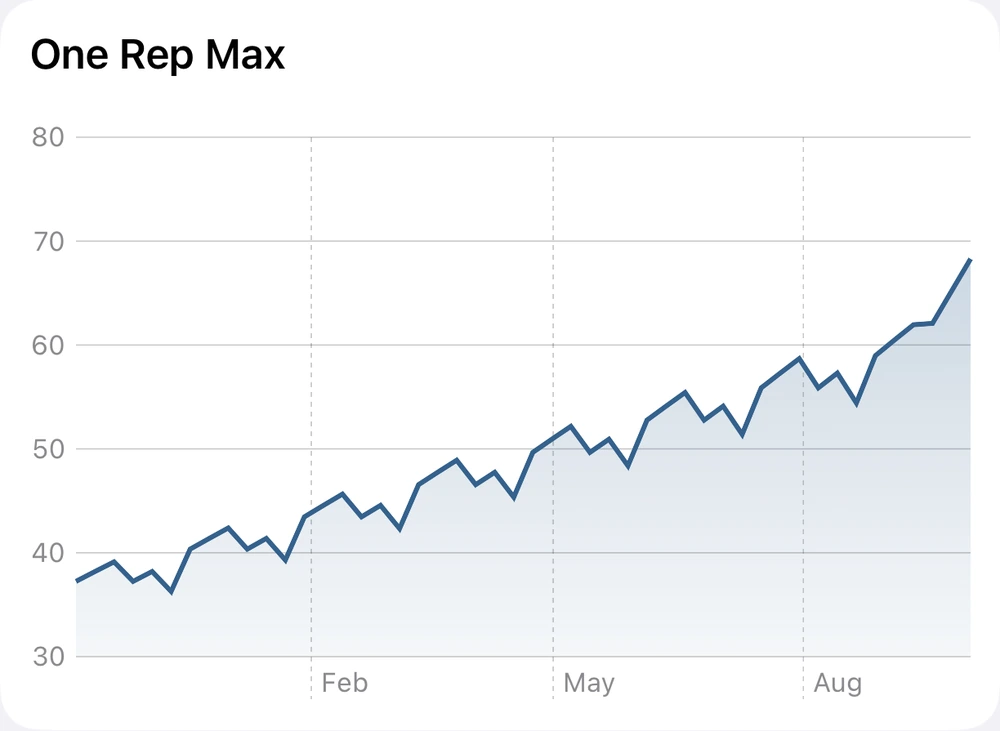
- The recent rise follows the 50 → 52.5 → 55 kg sessions. The longer history includes lighter work and fluctuations too.
- An estimated 1RM is not a tested maximum. Effort and conditions can change it without a matching change in strength.
You do not need a perfectly rising line. Look for improvement across comparable performances over time. Your log describes what you lifted; it does not directly measure muscle growth or prove why a result changed.
Decide what to keep, check, or change.
- Targets are improving: keep following the plan. Apply its progression rule when you meet the conditions. Do not replace something that is working just for variety.
- One session was worse: note unusual context and check the next comparable sessions. One off day is not enough to diagnose a plateau.
- Several comparable sessions are flat: check attendance, load increments, rest, effort, and recovery before adding more work. Your log alone cannot identify the cause.
- Performance is repeatedly falling: review the training demands and recovery together. A lighter period or a program adjustment may make more sense than forcing heavier sets.
Choose one change when possible and decide what evidence you will look for over the next several sessions. Changing exercises, sets, load, and rest together makes it hard to know what helped. If you need help adjusting the plan, bring the log to a qualified coach. Pain or injury calls for appropriate professional advice, not a higher target.
Strength trends and training summaries
Once you understand individual lifts, the 1RM Index can put exercise estimates on a shared scale relative to your own bests. Weekly volume adds context about work completed. Neither is a score to maximize: exercise mix, lighter blocks, and older estimates fading out can move the index.
How the 1RM Index worksWant help reviewing the evidence? AI Training Summary prepares your log and chosen goal as text you can inspect and share with an external assistant. Ask which sessions support its suggestion and what remains unknown. Sharing is your choice; the app does not upload it automatically or provide a built-in AI coach.
How AI Training Summary worksPut it into practice
Finish your review with one sentence.
“My Chest Press reps are improving at 55 kg with similar effort, so I will keep the load and build toward 10, 10, 10.”
Or: “The last few sessions are flat and rest has been inconsistent, so I will restore my planned rest and compare the next few sessions before changing the program.”
Your next workout now has a reason behind it. Keep the structure, log what happens, and use the next review to check your decision. The aim is to put what you learn into practice, rather than keep collecting analysis.