Training essentials · Step 1 of 4
Give your next workout a starting point.
You finish a workout feeling tired. But what should you repeat next time? What would count as improvement? A useful plan answers those questions before you start, so you are not deciding halfway through your first exercise.
This guide follows a simple loop: plan work you can repeat, train with a clear target, progress when you are ready, and review what happened. Strength Direct keeps the plan, previous sets, and results together so you can spend less time reconstructing last week.
Choose a routine you can actually repeat.
Start with a structured program suited to your goal, experience, available equipment, and realistic training schedule. A manageable routine you can follow is a better starting point than an ambitious one you regularly miss. If you are new, a qualified coach can help with program selection and technique.
Before a session, know these four things:
- The exercises: which variations you will do, and in what order.
- The working sets and rep targets: what work the session calls for, separate from your warm-up.
- The effort and rest: how close to your limit the sets should be, and how much recovery to allow between them.
- The progression rule: what needs to happen before you add reps or load.
Keep the main exercises stable long enough to practice them and compare several sessions. You can change a plan when needed; changing it every workout makes it harder to tell what is working.
Make “do better” specific.
We will follow one fictional Chest Press example through the guide. It illustrates a decision process, not a complete program or a prescription for your training.
- The plan: three working sets of 8–10 reps, using the same machine, setup, and controlled range of motion.
- The effort: finish with about two good reps left. Rest long enough to repeat the work; this example uses three minutes between working sets.
- The progression rule: build toward 10, 10, 10 at the intended effort before making a small load increase.
Suppose the last session was 55 kg for 8, 8, and 7 reps. The next goal is not automatically 57.5 kg. It is to work toward the rep targets at 55 kg without giving up technique or pushing beyond the intended effort. Now the next session has a purpose.
Save the structure. Leave room for the result.
In Strength Direct, open Workout → New Template and add your routine’s exercises and planned sets. Reuse it instead of rebuilding the session each visit. Push, Pull, and Full Body starter templates are also available; adapt the structure to your program rather than treating a template name as a complete training prescription.
Both reps and weight are optional in a template. A useful starting approach is to fill in only your rep targets and leave the weight blank. That keeps the structure ready without fixing the load for every future session.
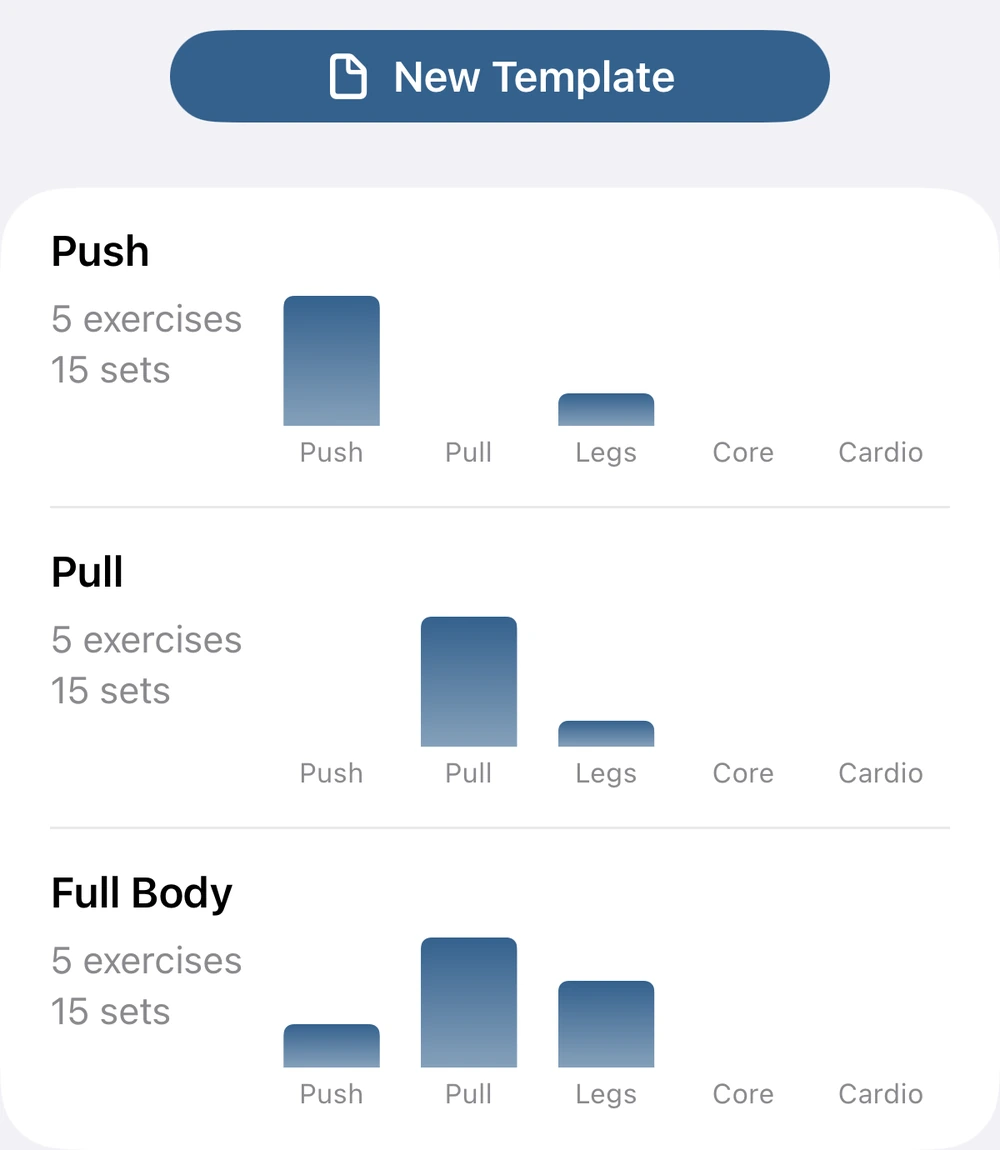
- Keep the exercises and planned sets you want to repeat in a template.
- Save rep targets without a fixed weight, then choose the load each session.
During each session, use the previous sets shown beneath your entries to choose a starting load. Apply your progression rule: build reps at the same weight, or make a small weight increase when you are ready. The session’s estimated 1RM helps compare those options, while the intensity label puts the combination in context against your history. Neither replaces your planned effort or good technique.
After lifting, update the reps and weight to what you actually completed. Your template holds the plan; the session records the result. The next chapter shows how to put that into practice.
Put it into practice
Start by preparing just one session.
- Choose the next session from your program and save its template.
- Know its rep targets, intended effort, and progression rule.
- Put the session in a time slot you can realistically keep.
You are ready when: you can explain what you will repeat and what would justify an increase. That gives you more direction than simply choosing which muscles to train.