Training essentials · Step 2 of 4
Before the first set, look at last time.
A workout log is not just an archive. It helps answer a question while you train: what is a sensible target today? Start your routine, check the previous completed sets, and warm up before settling on your working load.
In our fictional Chest Press example, the plan is three sets of 8–10 reps with about two good reps left. Last time was 55 kg for 8, 8, and 7. Keep 55 kg and work toward 8, 8, 8 if today’s technique and effort allow it. You have a direction, not an obligation to beat every set.
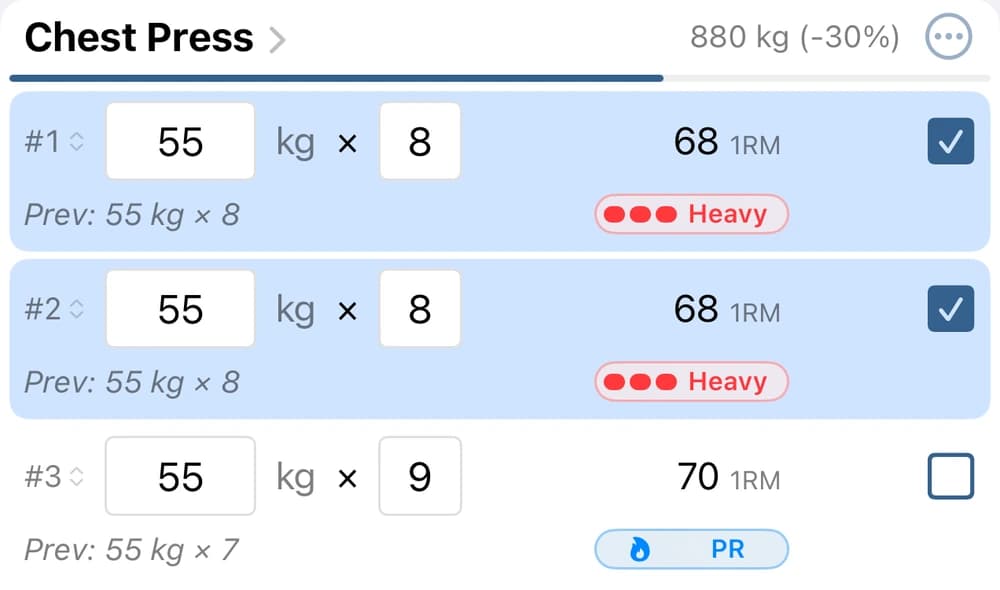
- The Prev lines show 55 kg for 8, 8, and 7 reps. No need to search an old workout mid-session.
- Only the first two current sets are checked. The nine-rep entry is still unfinished, so it does not yet count as an improvement.
No previous session? Follow your program’s starting guidance and choose a manageable load you can control at its intended effort. Your first honest record gives you a reference for next time.
Make the quality of each rep count.
An extra rep is useful evidence when it is the same task. Keep the machine or exercise variation, setup, and range of motion consistent. Shortening the movement just to finish a target makes the comparison less meaningful.
Effort matters too. Reps in reserve (RIR) is an estimate of how many more reps you could do with the intended technique. RIR 2 means about two left; RIR 0 means none. In this example, stop around two reps short rather than forcing a tenth rep to failure just to meet the number. Your own program may call for a different effort.
You do not need to take every set to failure to progress. RIR takes practice to estimate, especially when you are new. Treat it as context, not a precise measurement. Stop for pain rather than trying to preserve a target.
Strength Direct can record RIR if you enable Profile → Workout Tracking → Track Reps In Reserve (RIR). It is optional; leaving it blank means unknown, not zero reps left. The app’s intensity badge compares load and reps with your history. It does not measure effort.
Give the next set a fair chance.
Rest supports the work; it is not wasted time. Rushing into the next set can reduce the reps you can complete. Use your program’s rest guidance and allow enough recovery to perform the next set with the intended technique and effort.
Our example uses three-minute rests. That is a reference, not a universal rule. Keep rest reasonably similar across sessions when comparing results; if you need longer today, take it and note the change rather than racing the timer.

- Set a default in Profile → Rest Timer, or a duration for an individual exercise. Completing a working set starts the countdown.
- The blue countdown is rest, not total workout time. Warm-ups and drop sets skip it; supersets start it after the final exercise.
Record the result while it is fresh.
Enter the load and actual reps, then mark the set complete. If the plan says ten but you do eight, record eight. Separate warm-ups from working sets. In Strength Direct, completed working and drop sets contribute to analytics; warm-ups and unfinished sets do not.
Keep load conventions consistent: dumbbell loads are per dumbbell; the bodyweight input is added weight, not your body weight. Notes only need to capture useful context, not narrate every workout.

- This session note preserves a technique reference: Smooth reps; no bouncing. Other useful context includes a different machine or longer rest.
- For a setup reminder you want in every session, use a persistent exercise cue instead of repeating the same note each time.
If today ends at 55 kg for 8, 8, 8 with similar technique, rest, and effort, you have one more completed rep than last time. That modest result is useful. You do not need a new weight or a PR badge for the session to move you forward.
Put it into practice
Give one exercise your full attention.
- Check the previous sets and choose a target within your plan.
- Use repeatable technique, appropriate effort, and enough rest.
- Log each result; add a short note only if something changed.
Leave knowing: what you actually did, and whether it is comparable to last time. Next, use that record to decide when to add reps or load.
Need a starting structure? Start with a repeatable plan